
Letter to the Editor: Concept & Purpose
A letter to the editor is formal written communication addressed to a newspaper or magazine editor, written by a concerned citizen, professional, or stakeholder to bring attention to a public issue, raise awareness, persuade readers and authorities, or suggest solutions to a problem that affects society. It is published in the newspaper and reaches a wide audience, making it a powerful tool for civic participation and social responsibility.
Key Characteristics
✓ Formal & Professional: Maintains respectful, dignified tone throughout
✓ Purpose-Driven: Clearly states the issue and calls for action
✓ Evidence-Based: Supported by facts, statistics, and real examples
✓ Solution-Focused: Suggests practical, actionable solutions
✓ Civic-Minded: Demonstrates social responsibility and community awareness
✓ Concise: Strictly limited to 150 words (body only)
*Affiliate link. As an Amazon Associate, this website earns from qualifying purchases.*
📚Top Pick for Toppers & Teachers!
Organize your study notes with the Pilot Hi-Tecpoint V5 Multi-Color Pens Package on Amazon.
Format & Structure
Sender’s Address
Date (Day Month Year)
The Editor
(Newspaper Name)
(Newspaper Address)
Subject: (Brief topic – 5-8 words)
Sir/Madam,
[INTRODUCTION – State the issue]
[BODY – Elaborate with details/examples]
[CONCLUSION – Suggest solutions/appeal]
Yours truly,
(Your Name)
(Your Designation – if any)
Detailed Explanation
1. SENDER’S ADDRESS (Top Left)
24, Green Park
New Delhi – 110016
- No name here
- Include pin code
- No punctuation at line ends
2. DATE
15th March 2024
OR
15 March 2024
- British format: Day-Month-Year
- Write month in words
3. RECEIVER’S ADDRESS
The Editor
The Times of India
Bahadur Shah Zafar Marg
New Delhi – 110002
- Always ‘The Editor’
- Name of publication
- Address (can be brief)
4. SUBJECT LINE (Underlined)
Subject: Increasing noise pollution in residential areas
- Brief and specific
- No full stop at the end
- Underline
5. SALUTATION
Sir/Madam
- Always formal
6. BODY (3 Paragraphs)
PARAGRAPH 1: INTRODUCTION (2-3 lines)
- State the issue
- Mention how you know about it
- Reference any article (if applicable)
Example:
“Through the esteemed columns of your newspaper, I wish to draw public attention to the alarming increase in noise pollution in our residential area.”
PARAGRAPH 2: ELABORATION (4-5 lines)
- Provide details
- Give examples
- Mention consequences
- Use facts/statistics (if applicable)
Example:
“The peace of our locality has been shattered by loudspeakers during late hours, honking vehicles, and construction activities. Residents, especially students and senior citizens, are suffering from stress, sleep disorders, and health issues. Despite complaints to local authorities, no concrete action has been taken.”
PARAGRAPH 3: CONCLUSION (2-3 lines)
- Suggest solutions
- Make an appeal
- Express hope for action
Example:
“I request the authorities to enforce noise pollution norms strictly and impose penalties on violators. I hope this issue receives urgent attention through your reputed daily.”
7. COMPLIMENTARY CLOSE
Yours truly,
Rajesh Kumar
(Concerned Citizen)
- Capital ‘Y’, small ‘t’
- Put comma after ‘truly’
- Your name on the next line
Essential Language Features
A. Formal Expressions
Opening Phrases:
- Through the esteemed columns of your newspaper…
- I wish to draw attention to…
- I would like to express my concern regarding…
- This refers to your article published on…
- I am writing to highlight…
In the Body:
- It is a matter of grave concern that…
- The situation has deteriorated to such an extent that…
- This has resulted in…
- The consequences are far-reaching…
- Despite repeated complaints…
Concluding Phrases:
- I hope this issue receives prompt attention…
- I request the concerned authorities to…
- I trust you will publish this letter…
- Immediate action is imperative…
- I hope my voice will be heard through your reputed daily…
B. Persuasive Techniques
- Use Facts & Statistics
- “According to recent surveys, 60% of residents face this problem.”
- Appeal to Emotions
- “Children and elderly citizens are the worst affected.”
- Logical Reasoning
- “If this continues, it will lead to serious health hazards.”
- Cite Authority
- “The Municipal Corporation guidelines clearly state…”
Important Questions (NEP 2020- Aligned)
Advanced Analytical Questions (R1) – With Model Solutions
QUESTION 1
Consider the following information about Air Quality in your city over the last six months:
Air Quality Index (AQI):
- January: 385 (Severe)
- February: 342 (Very Poor)
- March: 298 (Poor)
- April: 256 (Poor)
- May: 289 (Poor)
- June: 312 (Very Poor)
Major Pollution Sources Identified:
- Vehicular emissions: 42%
- Industrial pollution: 28%
- Construction dust: 18%
- Crop burning: 12%
Health Impact:
- 67% of residents report respiratory problems
- 45% of children miss school due to pollution-related illness
- Hospital admissions increased by 34%
You are Aryan/Arya. Write a letter to the editor of a national daily expressing concern about air pollution in your city and suggesting effective measures to address the major pollution sources. (120-150 words)
SOLUTION
23, Sector 12
New Delhi – 110016
15 March 2024
The Editor
The Times of India
Bahadur Shah Zafar Marg
New Delhi – 110002
Subject: Alarming air pollution data demands urgent action
Sir/Madam
Recent municipal survey data reveals a critical environmental crisis. Our city’s AQI has remained consistently above 250 for six months, with January recording a dangerous 385. This persistent severe pollution has caused respiratory problems in 67% of residents, whilst 45% of children miss school due to related illnesses. Hospital admissions have surged by 34%, straining healthcare infrastructure.
Analysis shows vehicular emissions contribute 42% of pollution—the highest source. Industrial pollution (28%) and construction dust (18%) are other major contributors. These statistics demand targeted intervention, not generic solutions.
I propose immediate implementation of odd-even vehicle schemes during peak pollution months, mandatory emission testing with heavy penalties, and strict enforcement of industrial pollution norms. Construction sites must use dust-suppression techniques. Public transport should be strengthened urgently. Only data-driven policies can reverse this health emergency.
Yours truly,
Aryan Mehta
QUESTION 2
SCENARIO: Community Waste Management Challenge
Your Resident Welfare Association shared this information:
Current Situation:
- 150 households generate approximately 300 kg waste daily
- Only 40% households segregate waste
- Municipal collection is irregular (3-4 times weekly instead of daily)
- No recycling facility within 5 km
- Plastic waste: 35% | Organic waste: 50% | Other: 15%
Available Resources:
- Community hall basement (200 sq ft available)
- ₹25,000 annual RWA welfare fund
- 15 resident volunteers
- One retired agricultural scientist in the community
Constraints:
- Cannot rely on municipal corporation improving services
- Must use existing resources
- Solution must be sustainable without continuous funding
You are Shreya/Shrey. Write a letter to the editor of a local newspaper explaining this waste management challenge and proposing an innovative, self-sustaining community-based solution that uses available resources effectively. (120-150 words)
SOLUTION
45, Green Valley Apartments
Pune – 411030
20 April 2024
The Editor
Pune Mirror
Pune – 411001
Subject: Community-based solution for waste management crisis
Sir/Madam
Our housing society faces a waste crisis: 300 kg daily waste with only 40% segregation and irregular municipal collection. Rather than waiting for government intervention, we can implement a self-sustaining community solution.
I propose establishing a micro-composting unit in our community hall basement using the retired agricultural scientist’s expertise. Our 50% organic waste (150 kg daily) can produce valuable compost for our gardens, generating revenue through sales. The ₹25,000 fund can purchase a small composting machine and segregation bins. Fifteen volunteers can manage the initiative in rotation.
Simultaneously, partnering with local recycling vendors for plastic waste (35%) creates another revenue stream whilst reducing landfill burden. Educational workshops will increase household segregation from 40% to 80%. This model is replicable across housing societies, potentially transforming urban waste management. Communities must become solution-creators, not problem-reporters.
Yours truly,
Shreya Joshi
QUESTION 3 (Visual-Based)
The following photographs were taken at 8:30 PM in a residential locality:
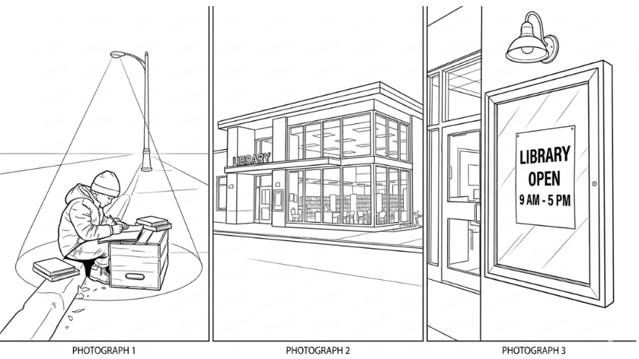
Photograph 1: A child studying under a street light
Photograph 2: A well-lit, modern library building nearby, but closed
Photograph 3: Library notice board showing timings: ‘Open 9 AM – 5 PM’
On enquiry, it was found that:
- The child is a ragpicker’s son who works during the day
- The library has over 5,000 books but serves only 20-30 users daily
- Most library users are retired persons who visit during daytime
- Working-class children cannot access the library due to its timings
You are Madhav/Madhavi. Write a letter to the editor of a national daily highlighting the issue of library accessibility and suggesting measures to make libraries truly inclusive. (120-150 words)
23, Gandhi Nagar
Bhopal – 462001
15 March 2024
The Editor
The Times of India
Bahadur Shah Zafar Marg
New Delhi – 110002
Subject: Making libraries accessible for all children
Sir/Madam
The powerful photograph of a child studying under a street light whilst an empty, well-lit library stands nearby reveals a profound irony in our education system. The image speaks volumes about accessibility versus availability.
The library’s 9 AM-5 PM timings serve retired citizens comfortably but exclude working-class children who return from work or school only by evening. This child, possessing eagerness to learn, is denied resources not due to their absence but due to systemic design favouring privileged schedules. True educational equity means infrastructure adapts to serve the marginalized, not merely exists.
I propose extending library hours until 9 PM, especially in areas with working-class populations. Evening study halls with basic tutorial support would transform lives. Mobile library vans can reach children unable to access permanent facilities. These solutions require minimal additional investment but maximum inclusive thinking. Education infrastructure must serve those who need it most, not those most convenient to serve.
Yours truly,
Madhavi Sharma
QUESTION 4
Read the following expert opinions on academic pressure in schools:
Dr. Anjali Mehra, Child Psychologist, states: “Competitive pressure in schools has reached toxic levels. Children as young as 8 years experience anxiety disorders. We’re creating academic achievers but emotionally damaged individuals.”
However, Mr. Rajesh Khanna, Education Policy Expert, argues: “Competition prepares children for real-world challenges. Countries with rigorous academic standards produce globally successful professionals. Reducing standards will make our students globally uncompetitive.”
Ms. Priya Iyer, a parent and teacher, offers a different perspective: “The question isn’t competition versus no competition, but healthy competition versus destructive pressure. We need balance, not extremes.”
Recently, a Class 9 student in a school attempted self-harm after scoring 78% in exams, as the school average was 82%.
You are Samar/Samira, a concerned student. Write a letter to the editor of a national daily analyzing these viewpoints and suggesting how schools can balance academic excellence with student well-being. (120-150 words)
67, Indiranagar
Bangalore – 560038
20 April 2024
The Editor
The Hindu
Kasturba Gandhi Marg
New Delhi – 110001
Subject: Redefining academic excellence beyond percentage race
Sir/Madam
Dr. Mehra’s concern about toxic competitive pressure and Mr. Khanna’s argument for rigorous standards appear contradictory, yet Ms. Iyer’s balanced perspective reveals they address different aspects of the same challenge. Last week’s tragic incident—a student attempting self-harm after scoring 78%—validates Dr. Mehra’s warning whilst exposing our distorted definition of success.
The core issue isn’t competition itself but our narrow measurement of excellence exclusively through marks. Countries with successful education systems like Finland prioritize holistic development alongside academics. True global competitiveness emerges from creative, confident, mentally healthy individuals, not anxious mark-scorers.
I propose schools adopt comprehensive assessment valuing creativity, critical thinking, and emotional intelligence alongside academics. Replacing percentage displays with grade systems reduces unhealthy comparison. Mandatory counseling support and parent education workshops can shift focus from marks to learning. Excellence and well-being aren’t opposing goals—our current system’s narrow metrics make them appear so.
Yours truly,
Samira Reddy
QUESTION 5
Read the following information carefully:
Rani, a 14-year-old girl, works as a domestic helper in four houses from 6 AM to 11 AM before attending a government school. She earns ₹4,000 per month to support her ill mother and two younger siblings. Her father abandoned the family.
Teachers observe that Rani arrives exhausted and often falls asleep during classes. However, when awake, she answers questions correctly, showing her intelligence. Recently, her school issued a warning letter for “lack of interest and repeated sleeping in class,” stating that if her attendance and performance don’t improve, she may be asked to leave.
Rani says, “I want to study, but my family needs money. If I sleep more, we don’t eat.”
You are Arjun/Aanya. Write a letter to the editor of a national daily highlighting the challenges faced by economically disadvantaged students and suggesting how the education system can support such students. (120-150 words)
45, Malviya Nagar
Jaipur – 302017
10 May 2024
The Editor
The Indian Express
Bahadur Shah Zafar Marg
New Delhi – 110002
Subject: Education system must recognize diverse student realities
Sir/Madam
Rani’s story exposes the cruel irony in our education system. A fourteen-year-old working four hours before school to feed her family is punished for exhaustion with the same standards applied to well-rested, privileged students. Her warning letter for ‘lack of interest’ demonstrates our system’s blindness to structural inequality.
Teachers labeling her disinterested whilst she battles impossible choices—education versus family survival—reveals systemic failure to recognize diverse realities. Rani proves her intelligence when awake, yet uniform attendance policies designed for privileged circumstances threaten to push her out permanently. We celebrate education as the ‘great equalize’ whilst designing systems that systematically exclude the marginalized.
Schools must implement flexible timing for working students, provide mid-day rest facilities, and offer evening tutorial support. Financial assistance programmes should identify such cases proactively. Education policy assuming all students have equal socio-economic starting points perpetuates inequality whilst claiming to address it.
Yours truly,
Aanya Kapoor
QUESTION 6
Your school generates the following waste daily:
- Used notebooks after academic year: 400+ notebooks
- Old newspapers: 5 kg
- Broken furniture: 15-20 items annually
- Old textbooks: 300+ books per year
- Plastic bottle caps: 200+ caps
Currently, everything goes to trash, and the school pays ₹12,000 monthly for waste disposal.
You learned from a documentary that art schools use waste creatively, recycling centers pay for certain materials, and NGOs collect items for underprivileged children.
You are Diya/Dhruv, member of the Eco Club. Write a letter to the editor proposing a “zero-waste school” model that is self-sustaining and could inspire other schools. (120-150 words)
56, Model Town
Lucknow – 226010
12 May 2024
The Editor
The Indian Express
Bahadur Shah Zafar Marg
New Delhi – 110002
Subject: Transforming school waste into educational and economic resource
Sir/Madam
Our school discards valuable resources whilst paying ₹12,000 monthly for disposal. Reimagining waste as resource can create a self-sustaining zero-waste model benefiting education, environment, and economics simultaneously.
I propose an integrated approach: used notebooks and old newspapers sold to recycling centers generate approximately ₹3,000 monthly, whilst old textbooks donated to underprivileged students through NGO partnerships fulfill social responsibility. Art classes can transform broken furniture and cardboard into creative projects, teaching upcycling whilst saving material costs. Collected plastic bottle caps—200 daily—can be sold to recycling units specifically collecting caps for prosthetic limb manufacturing, adding purpose to recycling.
This converts ₹12,000 monthly expense into potential ₹3,000+ income whilst creating environmental awareness and social impact. Students gain experiential learning in sustainability, resource management, and social entrepreneurship. The model requires zero investment, only systematic collection and partnerships. This replicable framework could transform waste management across educational institutions from cost burden to opportunity.
Yours truly,
Diya Malhotra
Eco Club Member
For official academic guidelines and updates, you can refer to CBSE Academic Website