
Word limit: 120-150 words
What is a Magazine Article?
A magazine article is a piece of semi-formal writing published in a school or general magazine to inform, express views, or persuade readers on a topic of general interest. Unlike a notice or letter, it is meant to be read by a wide audience — so it must be engaging, well-organised, and clearly argued.
*Affiliate link. As an Amazon Associate, this website earns from qualifying purchases.*
📚Top Pick for Toppers & Teachers!
Organize your study notes with the Pilot Hi-Tecpoint V5 Multi-Color Pens Package on Amazon.
Format
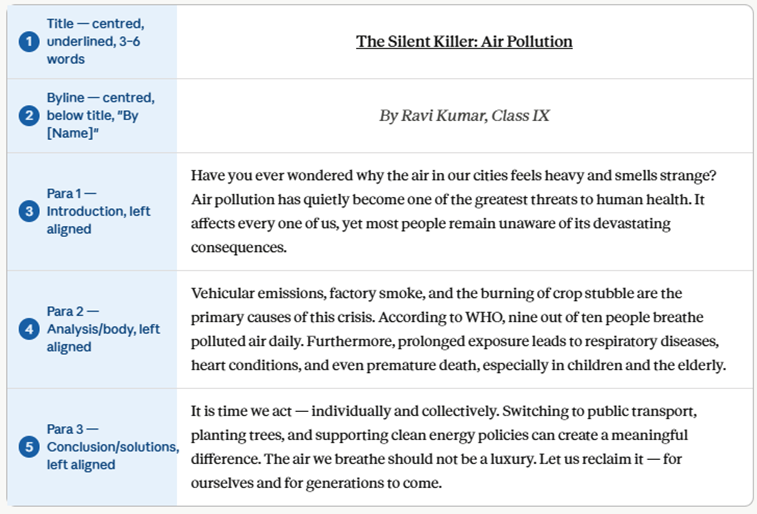
1. Title / Heading (Centre aligned & Underlined )
Must be catchy, precise, and directly related to the topic. Written in Title Case and underlined. Keep it short — ideally 3 to 6 words. A good title makes the reader want to read further.
2. Byline (Centre aligned)
Written immediately below the title. It tells the reader who has written the article. Always begin with the word ‘By’ followed by your name and class or designation. This is mandatory to write, as it is counted as part of the format for marks.
3. Paragraph 1 — (Left aligned)
Introduction
3–4 lines. Introduce the topic and tell the reader why it matters. Open with a hook — a striking fact, a rhetorical question, a short anecdote, or a bold statement — to grab attention immediately.
4. Paragraph 2 —(Left aligned)
Detailed analysis
The main body — 5–6 lines. Discuss causes, effects, current scenario, facts, examples, or advantages and disadvantages. Support every point with a logical reason or a real-world example. Use linking devices to connect ideas smoothly.
5. Paragraph 3 — (Left aligned)
Conclusion
3–4 lines. Never leave the article open-ended. Give solutions, suggestions, a call to action, or a final thought for the reader to reflect upon. The conclusion must feel like a complete, satisfying end — not an abrupt stop.
The ‘5 Ws’ Trick for Paragraph 2
Paragraph 2 is where you gain or lose 2 content marks. Use this trick to fill it perfectly:
Ask yourself these 5 questions and answer one per sentence:
1. WHAT is the problem/issue?
Define it clearly with a fact or observation.
2. WHY does it exist? (Causes)
Give 1–2 causes with brief explanations.
3. WHAT are the effects? (Consequences)
How does it impact people? Give a real example.
4. WHO is affected most?
5. WHAT evidence supports your view? (Statistic/fact/example)
Memory Trick — T-B-I-A-C + The ‘Rule of 3’
Remember this formula:
T-B-I-A-C (Title, Byline, Introduction, Analysis, Conclusion)
RULE OF 3 FOR EVERY PARAGRAPH:
Para 1: Hook + Topic + Why it matters (3 ideas)
Para 2: Causes + Effects + Example (3 elements)
Para 3: Problem summary + 2–3 solutions + Closing line (3 actions)
ALSO REMEMBER:
3–4 lines per paragraph × 3 paragraphs = ~150 words ✓
1 fact per article = credibility ✓
1 linking word per category (Add/Contrast/Cause/Conclude) = good expression ✓
Article Writing Questions with Model Solutions
QUESTION 1
Many students silently suffer from anxiety, depression, and stress but do not speak up due to stigma and fear of judgment. Write an article for your school magazine urging students to break the silence surrounding mental health and reach out for help. Explain why speaking up is a sign of strength, not weakness, and how it can transform lives. (120–150 words)
The Silent Classroom: Why Students Must Speak Up
By Aditya Singh, Class X
While you sit in class today, the student next to you might be battling invisible demons. Anxiety, depression, and loneliness have become silent companions to countless students — yet we are conditioned to hide them. This silence is more dangerous than the illness itself.
Speaking up about mental health is not weakness; it is courage. Studies confirm that 1 in 7 adolescents faces a mental health condition, yet most suffer alone due to stigma. The real strength lies in admitting you are struggling and seeking help. School counsellors, trusted teachers, and helplines like iCall (9152987821) exist precisely for this. Bottling emotions only amplifies pain; sharing lightens the burden.
Let us be a generation that chooses healing over hiding. If you are struggling, reach out today. If your friend is silent, ask them if they are okay. A conversation can save a life. Your mind matters. So do you.
Value Points to Include
- Mental health is as real as physical health — statistics (1 in 7 adolescents)
- Stigma prevents students from seeking help — personal impact
- Speaking up is a sign of strength, not weakness — mindset shift
- Practical resources: counsellors, iCall, trusted adults
- Call to action: normalise conversations about mental health
QUESTION 2
India’s education system emphasises memorisation over understanding. Write an article for your school magazine arguing that students need conceptual learning, not rote memorisation, to solve real-world problems and succeed in the 21st century. (120–150 words)
Rote Learning Is Robbing Our Future
By Priya Sharma, Class IX
We have created a generation that can recite the entire periodic table but cannot solve a simple chemistry problem. Rote learning has become the default survival strategy — and it is costing our nation its future innovators, problem-solvers, and leaders.
When students memorise formulas without understanding concepts, they fail the moment the question format changes. Employers worldwide demand critical thinking, creativity, and adaptability — none of which are developed through rote memorisation. NEP 2020 recognises this, explicitly calling for a shift towards competency-based learning that emphasises application, analysis, and creation. Countries like Finland and Singapore have moved away from exams and memorisation, yet their students rank among the world’s best-problem solvers.
Schools and parents must support conceptual learning through projects, discussions, and real-world problem-solving. NEP 2020 is right — understanding matters far more than remembering. Let us teach students to think, not to recite.
Value Points to Include
- Problem with rote learning: no real understanding, fails beyond textbooks
- 21st-century skills needed: critical thinking, problem-solving, creativity, adaptation
- NEP 2020 explicitly calls for competency-based learning — shift in assessment
- Global examples: Finland, Singapore — success through conceptual learning
- Role of schools and parents in supporting this change
QUESTION 3
India has made extraordinary contributions to mathematics, astronomy, medicine, and philosophy thousands of years ago. Write an article for your school magazine arguing that we must take pride in India’s ancient scientific heritage and revive its study in schools. (120–150 words)
India Knew First: Celebrating Our Scientific Heritage
By Vikram Patel, Class X
Centuries before Europeans mapped the solar system, an Indian mathematician named Aryabhata declared that the Earth rotates on its axis. Centuries before modern surgery, Sushruta was performing complex operations with precision instruments. India’s ancient scientific heritage is not mythology, it is documented, verified history.
The concept of zero, the decimal system, the value of pi — all originated in India. The iron pillar of Delhi has stood for 1,600 years without rusting, baffling modern metallurgists. Charaka’s Ayurvedic treatises remain relevant in contemporary medicine. Yet most Indian students know Pythagoras but not Baudhayana, who stated the same theorem a thousand years earlier. This is not just ignorance — it is a loss of identity.
Integrating India’s rich knowledge traditions into school curricula bridges the gap between historical wisdom and modern education. Learning our scientific history does not diminish modern science — it deepens it. Pride in our past fuels the ambition to build our future. India did not just receive knowledge; it gave it to the world.
Value points to include
- Zero — Aryabhata; decimal system; Pythagoras theorem known 1000 years earlier in India (Sulbasutras)
- Sushruta — father of surgery; Charaka — Ayurveda; Chandragupta’s iron pillar — no rust in 1600 years
- Astronomy: Aryabhata knew Earth rotates on its axis; Brahmagupta’s gravitational theory
QUESTION 4
India’s traditional art forms — Madhubani, Warli, Pattachitra, Kathakali, Bharatanatyam — are struggling to survive as fewer young people learn them. Write an article for your school magazine urging students to learn and preserve at least one traditional Indian art form. (120–150 words)
Saving the Art That Tells Our Story
By Nandita Rao, Class IX
A Madhubani painting tells stories that no textbook can. A Kathakali performance carries centuries of emotion in a single gesture. Yet these magnificent art forms are slowly disappearing not because they lack beauty, but because they lack students willing to learn them.
India’s traditional arts — Warli, Pattachitra, Bharatanatyam, Kuchipudi — are living archives of our culture, philosophy, and history. However, modernisation, low incomes for artisans, and the absence of art education in most schools have left these traditions starved of the next generation of practitioners. When an art form dies, an irreplaceable piece of human civilisation is lost — and unlike a species, no technology can bring it back.
True education must integrate traditional art forms to cultivate a holistic understanding of our heritage. Every student should learn at least one traditional art form — not as a hobby, but as a duty. Buy from artisans. Visit craft fairs. Paint, dance, weave. Our art is our identity — let us not leave it to disappear in silence.
Value points to include
- Name 3–4 art forms: Madhubani (Bihar), Warli (Maharashtra), Pattachitra (Odisha), Kathakali (Kerala)
- Why dying: modernisation, low income for artisans, no school exposure, globalisation
- Why preserve: national identity, cultural continuity, UNESCO recognition, livelihood for artisans
- What students can do: learn one art form, support artisans, include in school curriculum
QUESTION 5
The gig economy (freelancing, online work, contract jobs) is growing rapidly in India. Young people are increasingly choosing flexible work over traditional jobs. Write an article for your school magazine discussing whether the gig economy offers real opportunity or masks job insecurity. Include advice for students choosing their career path. (120–150 words)
The Gig Economy: Opportunity With a Catch
By Meera Patel, Class X
A flexible schedule, no boss, work from anywhere — the gig economy promises freedom. Yet beneath the glamour lies a harsh reality: no fixed income, no health insurance, no job security. Is this truly opportunity, or a beautifully disguised trap?
The gig economy offers flexibility and income diversification, perfect for entrepreneurs and those seeking autonomy. However, income is unpredictable, benefits are absent, and burnout is common. In India, where 400 million people lack social security, gig workers are particularly vulnerable. The COVID-19 pandemic exposed this — millions lost all income overnight. Yet gig work has also created opportunities for women, differently-abled individuals, and those in remote areas.
The gig economy is neither evil nor saviour — it is a choice with trade-offs. Before entering, ask: Do I have savings? Can I work while building skills? Do I have alternate income sources? Choose wisely.
Value Points to Include
- Advantages of gig economy: flexibility, autonomy, diverse income, inclusivity
- Disadvantages: unpredictable income, no benefits, job insecurity, burnout risk
- India-specific context: 400 million lack social security — vulnerability of gig workers
- COVID-19 example: sudden income loss for millions
- Balanced view: neither all good nor all bad — choice with trade-offs
QUESTION 6
Many students are ashamed to speak their mother tongue in public, believing English is superior. NEP 2020 calls for mother tongue as a medium of instruction. Write an article for your school magazine explaining why your mother tongue is not a limitation but your greatest intellectual asset. Connect this to learning, identity, and cognitive development. (120–150 words)
Mother Tongue: The Language of Our Soul
By Aisha Khan, Class IX
When you speak your mother tongue, neurons fire more efficiently, creating stronger neural pathways. Yet many of us are taught to be ashamed of this most powerful language. We chase English fluency while losing our own linguistic treasure.
Research proves children learn concepts faster in their mother tongue. UNESCO calls language extinction “a loss of intellectual and cultural heritage.” Mother tongue enables deeper understanding, stronger identity, and faster cognitive development. Tamil is older than Latin; Sanskrit has 172 words for water. These are not backward languages, they are repositories of civilisation.
Speak your mother tongue proudly. Learning English is essential, but at the cost of your own language? Never. Multilingualism is the future. Be proud of where you come from. Your language is your power.
Value Points to Include
- Science backing: faster learning, stronger neural pathways in mother tongue
- Cultural heritage at stake: language extinction = loss of civilization
- Language examples: Tamil’s antiquity, Sanskrit’s precision — evidence of richness
- Multilingualism as future — English + mother tongue, not either/or
QUESTION 7
Women make up 50% of the population but hold less than 10% of leadership positions in India. Write an article for your school magazine examining why women’s voices are underrepresented in decision-making and what needs to change. Include both systemic barriers and personal empowerment strategies for young women. (120–150 words)
Hear Her Voice: Why Women’s Leadership Matters
By Zara Desai, Class X
Every decision made without women’s input is a decision made by half an intellect. Yet in India’s boardrooms, courts, and cabinets, women remain conspicuously absent. This is not a women’s problem — it is a leadership crisis.
Women face systemic barriers: workplace discrimination, family pressure, socialisation into silence. Companies with female leaders show 15% higher profitability — yet women remain sidelined. Article 14 of the Constitution guarantees equality; yet societal conditioning teaches women to be invisible. Young women must unlearn this. Speak in class. Lead projects. Run for student council. Claim your space unapologetically.
Society must dismantle barriers; women must dismantle self-doubt. When women lead, nations thrive. Your silence will not keep you safe — but your voice will set you free.
Value Points to Include
- Systemic barriers: workplace discrimination, family pressure, gender socialisation
- Statistical evidence: women less than 10% in leadership, 15% higher profitability with women leaders
- Constitutional backing: Article 14 guarantees equality — gap between law and practice
- Personal empowerment: speak up, lead, claim space in school and beyond
- Societal change needed: both systemic reform and individual agency
QUESTION 8
India banned single-use plastic in 2022, yet violations continue. Write an article for your school magazine on why this ban failed and what individual and governmental action is needed. Focus on connecting plastic consumption to environmental justice — how the poor suffer most from our waste. (120–150 words)
Plastic: A Poor Person’s Burden
By Rohit Sharma, Class IX
India banned single-use plastic in 2022. Yet walk through any market, and plastic is everywhere. The rich discard plastic carelessly; the poor drown in it. This is environmental injustice masked as a ban.
The ban failed because enforcement was weak and alternatives were expensive. A ₹5 cloth bag seems cheap to an urban middle class, but not to a farmer or daily wage worker. Meanwhile, plastic waste clogs rivers in poor communities, enters groundwater used by marginalised populations, and accumulates in landfills built near slums. Rich neighbourhoods stay clean; poor neighbourhoods drown in waste. True enforcement requires subsidised alternatives, not just bans on the poor.
Real change needs both top-down policy (subsidised eco-alternatives, strict industry responsibility) and bottom-up action (refuse plastic, choose alternatives, demand accountability). Environmental justice means protecting the poor first.
Value Points to Include
- Ban exists but enforcement weak — gap between policy and practice
- Cost barrier: alternatives expensive for economically weak sections
- Environmental justice angle: poor communities bear burden of plastic waste
- Impact examples: river pollution, groundwater contamination, landfills near slums
- Solutions: subsidised alternatives, industry accountability, individual refusal, enforcement
QUESTION 9
Young voter turnout in India is declining. Many 18-year-olds see voting as irrelevant or meaningless. Write an article for your school magazine explaining why voting is not a duty but a superpower — how your vote directly affects education, jobs, climate policy, and your future. Connect this to your own life. (120–150 words)
Your Vote, Your Future
By Nikita Deshmukh, Class X
You scroll through Instagram ranting about potholes, water shortages, and pollution. Yet when voting day arrives, you stay home. Here is the truth: the potholes exist because people like you did not vote.
Your vote directly determines education policy, job creation, climate action, and infrastructure. The leader you elect decides whether schools get funding, whether careers exist in your fields, whether air quality improves. India’s 18-24 age group is 17 crore strong — if you all voted, you could decide any election. Yet only 25% do. Politicians ignore youth because youth ignore the ballot.
Voting is not a duty; it is democracy’s ultimate cheat code. When you turn 18, register immediately. Every vote is a choice: do you want this future, or a different one? Choose wisely.
Value Points to Include
- Direct impact of voting: education, jobs, climate, infrastructure policies
- Youth demographic power: 17 crore 18-24 year-olds can decide elections
- Problem: low turnout among youth — politicians ignore non-voters
- Voter registration and process details — actionable steps
- Reframe voting: not obligation but power, choice, personal interest
QUESTION 10
India gave the world zero, the decimal system, and Ayurveda — yet today, most Indians pursue careers in humanities or commerce, avoiding science. Write an article for your school magazine urging students to choose science careers, connecting India’s scientific heritage to modern innovation needs. Explain how India can lead globally in AI, space, and biotech. (120–150 words)
India’s Scientific Heritage: Our Unfinished Journey
By Arjun Iyer, Class X
Aryabhata discovered that Earth rotates on its axis centuries before Copernicus. Sushruta performed cataract surgery in 500 BCE with precision modern surgeons admire. Yet today, India imports technology instead of inventing it. This is not failure — it is interrupted potential.
India needs 2 million STEM professionals by 2030, yet most seats remain unfilled. The irony: India’s ancient scientists were inventors, observers, experimenters — exactly what modern science demands. Today’s challenges — AI, space exploration, renewable energy, biotech — require the curiosity Aryabhata had. India’s ISRO sends rockets to Mars on ₹100 crores; SpaceX spent billions. Imagine what India could achieve with more scientists, more investment, more pride.
Choose science. Not for marks or prestige, but because India’s next great discovery waits for you. Your generation can bring India’s scientific heritage back to life. The question is: will you answer the call?
Value Points to Include
- Historical evidence: Aryabhata, Sushruta, zero, decimal system — scientific legacy
- Current shortfall: 2 million STEM professionals needed, seats unfilled
- Modern context: AI, space, biotech, renewable energy — India’s potential
- ISRO example: cost-effective innovation compared to global competitors
- Call to action: young scientists as custodians of India’s scientific future
For official academic guidelines and updates, you can refer to CBSE Academic Website